
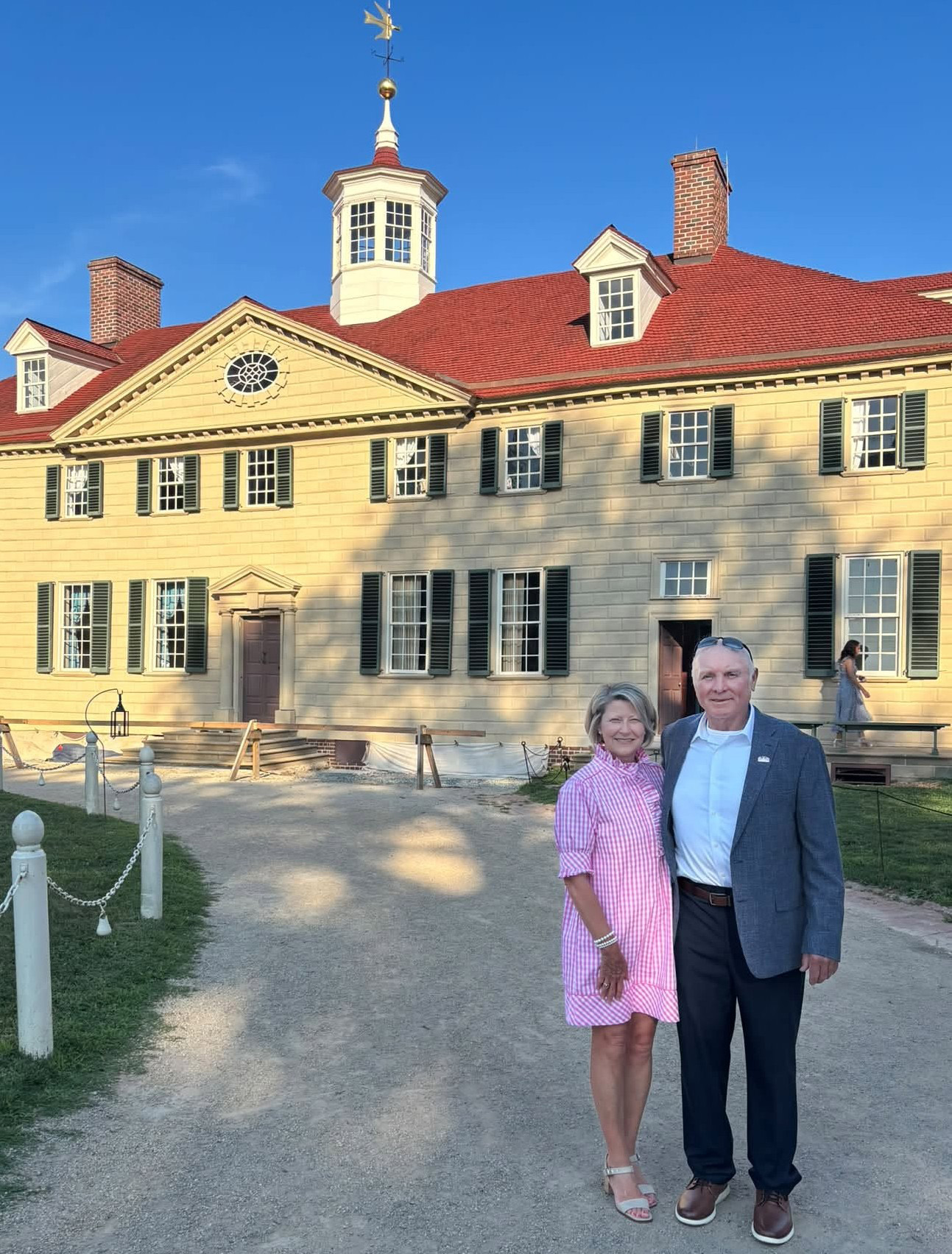
AGCO invited Billy Riney Jr., who started Riney Dairy 48 years ago, and his wife, Jerri, to the AG250 Dinner earlier this month at George Washington’s Mount Vernon, the plantation home of the nation’s first president in Virginia.
National campaign recognizes 10th-generation Kentucky dairy
By Chris Aldridge
Kentucky Ag News
Riney Dairy in Washington County is among three multi-generational family farms across the nation that AGCO Corp.’s Legacies of the Land campaign is highlighting. Their stories will be part of an interactive archive celebrating American agriculture during the nation’s 250-year semiquincentennial, with plans to preserve their oral histories through the Library of Congress.
Riney Dairy has been around for nearly a half-century, but the farm has been in the Riney family much longer, estimated between 200-250 years. AGCO invited Billy Riney Jr., who started the dairy 48 years ago, and his wife, Jerri, to the AG250 Dinner earlier this month at George Washington’s Mount Vernon, the plantation home of the nation’s first president in Virginia.
“Standing at George Washington’s home is a reminder of the deep roots of American agriculture and the generations of farmers who have helped build this country,” Riney Farms posted on its Facebook page. “It’s humbling to be included in an event celebrating agriculture’s past, present, and future.
“A sincere thank you to AGCO for the invitation and for recognizing the families who work every day to produce food and care for the land. We’re grateful to be a part of such a special evening and to represent our farm alongside so many outstanding people in agriculture.”
Billy’s son, John, is the 10th generation to continue his family’s farming tradition.
“It's really opened up my eyes to the legacy that we do have here,” John told AGCO. “The (farm)house was built by my great-great-great-grandfather, Thomas Blandford, in 1875.
The family’s roots trace back to the first generation, Clement Riney, to farm around Cartwright Creek in the late 18th or early 19th centuries. The farm has gone through many changes, the last in 1978.
“That was a big change for our farm,” John said. “My dad had gone to college thinking he was going to be a hog farmer.”
“They told me if I was going to make any money, I needed to be a dairy farmer,” Billy remembered. “I said, ‘I'm a dairy farmer now!’ …I got the cows and equipment in the afternoon and milked that night. That's the first time I had ever milked.”
When Billy started, he could only milk 18 cows an hour. Forty-eight years later, new technology has increased that number more than sevenfold to 130 cows per hour.
“That’s a huge difference,” Billy said. “Things change; You just got to be able to change with the times. If you don't, you'll be left behind.”
Riney Dairy was among 275 dairy farms in Washington County in 1978. Today, there are only two.
“There are a lot of families that … didn't have anybody that wanted to dairy, and I can't blame them,” John said. “Dairy farming is not for everybody. Every day, three times a day, somebody is milking. Rain, sleet, snow, or shine, you're out there.
“My dad never made me work, really. I've seen a lot of families that made their kids work on the farm, made them milk cows or made them feed cows in the mornings. And you know, it pushed them away.”
Billy did not think John would choose to take over the family farm. “I didn't think I was going to come back to the farm either, but I did,” Billy admitted.
John said his reason for staying was to give his four children the opportunity to become the 11th generation to carry on their family’s farming tradition.
“I just feel like in 40 or 50 years, they might not have the option,” John said, his voice breaking with emotion. “I didn't have to milk cows, but I think if we skip a generation, then it's going be too hard to start farming again. My main hope is for them (kids) to have the same opportunity that I had.
“Being a farmer in America, I don't think we realize how blessed we are. Agriculture has come a long way in 250 years. Sitting here now, it's hard to think about what might change even in the next five years. And that's why I think you just have to be ready to try new things. We're not stuck in our ways. If we see a better way to do something, we're going to try it for sure.”