
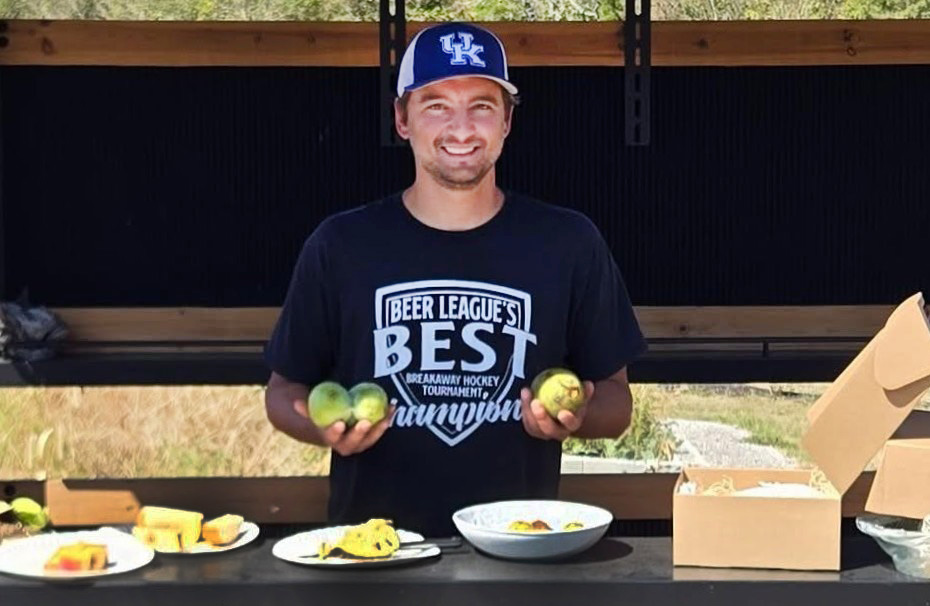
Matt Menegotto says the best way to eat pawpaws is fresh picked. Slice them in half and spoon out the mushy pulp or squeeze it out of the skin, but don’t eat the large seeds.
Jessamine County orchard growing Kentucky’s native fruit
By Chris Aldridge
Kentucky Ag News
Nine years ago, Matt Menegotto was at Lexington Farmers’ Market when he came across a lady selling large, yellowish-green fruit he had never seen before.
“I tried one, and I was like, ‘Holy smokes, what is this?’” said Menegotto, who admitted he was “absolutely hooked” on the taste. “She was like, ‘Oh, that's a pawpaw, the largest native fruit to North America and Kentucky…. Those grow wild here.’”
Commonly called the Kentucky banana, hillbilly mango, and American custard apple, Menegotto said pawpaws have the texture of a mushy banana with a tropical flavor, like a combination of banana, mango, and pineapple. The small trees on which they grow are native to eastern North America.
“I started doing research,” he said. “It blew my mind why nobody was growing this…. I was blown away that the world's only full-time, dedicated pawpaw research program is 20 minutes down the road at Kentucky State University.
“It seemed like a no-brainer,” he added. “I was like, ‘Well, why don't I just start a pawpaw orchard?’”
Menegotto did just that four years ago, planting 160 pawpaw trees on his 2½-acre Hang Loose Pawpaw Patch near Wilmore, Ky. The trees began bearing fruit last year, but there’s still not enough to sell to the public.
“Full production for us would be about 5,000 pounds, but we’ll be lucky to have a thousand pounds this year,” he said. Most of the current harvest, which runs from August to October, will go to Good Foods Co-op in Lexington.
“After the new year, you can sign up on a wait list and put down how many pounds you want,” he said. “Next year, I’ll go down the list filling orders until I run out of pawpaws.”
Hang Loose’s niche is the 15 different cultivars of pawpaws that Menegotto grows, each with different flavors and textures. His personal favorite is Susquehanna, noting, “Of course, that’s been the hardest one to grow.
“We’re going to do what no one else in the country is doing,” he added. “I plan to sell my pawpaws like apples, separated by cultivar. Most pawpaws are sold mixed together; you don’t know what you’re getting.”
Because pawpaws are native to Kentucky, losses to local pests are minimal. The only exception is the invasive ambrosia beetle, which have killed nearly a fifth (30 trees) of Menegotto’s orchard.
“If you find ambrosia beetles, you have to cut down the tree and burn it immediately,” he said. “The beetles’ saliva has a virus in it that kills the tree, then they lay eggs and spread all over your orchard. That’s why they’re called ‘The Orchard Killer.’”
Losses to deer and other orchard visitors are minimal as well. “Critters don’t eat pawpaws because the skin is really bitter,” Menegotto noted.
The biggest drawback to growing pawpaws is a very short shelf life of three to five days after picking. Like bananas, they also bruise easily, making shipping difficult. So, Menegotto turned his basement into a commercial kitchen with a pawpaw processing machine.
“Anything we don’t sell, we turn into pawpaw pulp, which is delicious,” he said. “You can freeze it, and it maintains its flavor pretty well.
“In the next five years, I would like to partner with a local brewery to make pawpaw beer or a dairy to make pawpaw ice cream,” he added. “Those are the two best value-added products for pawpaws.”