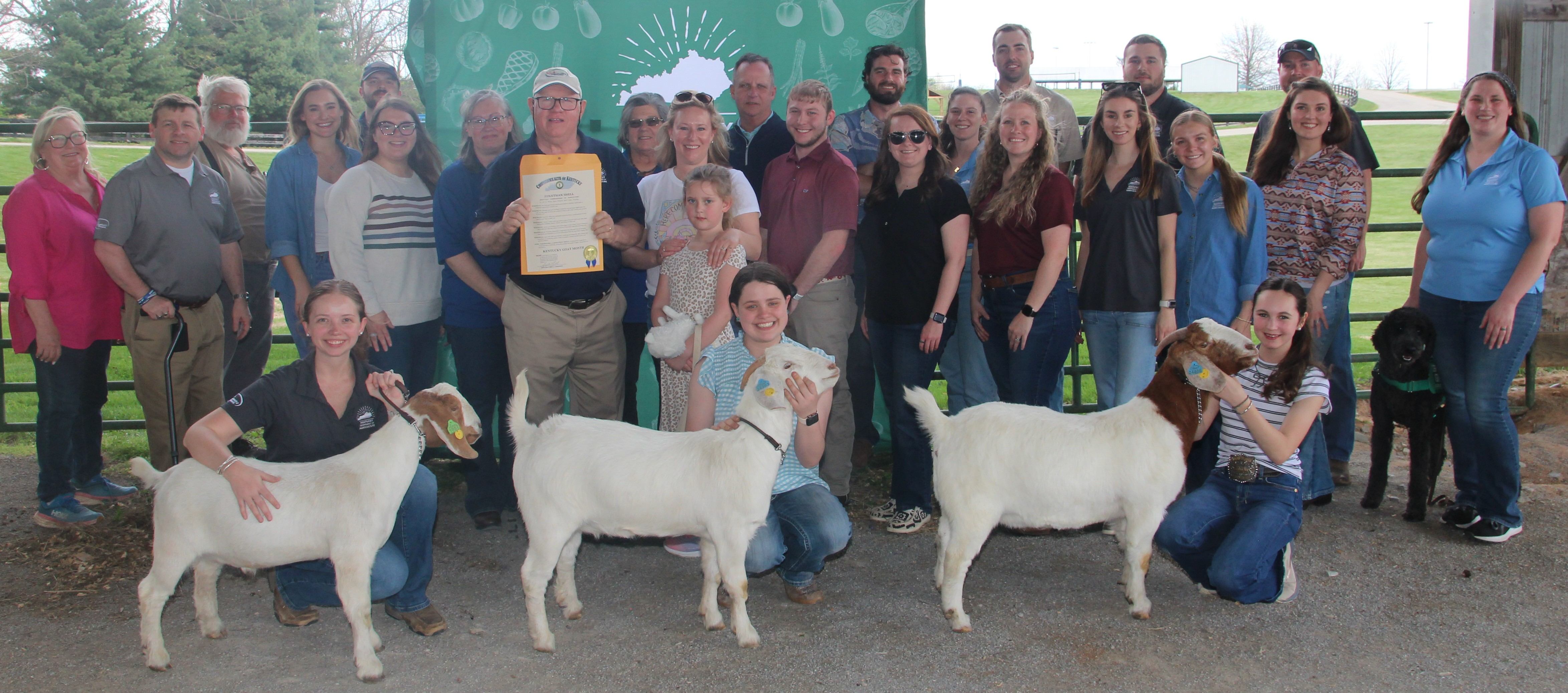
Kentucky Deputy Agriculture Commissioner Warren Beeler holds a proclamation designating April as Goat Month in Kentucky. Beeler was joined at the signing Wednesday at Lakeview Park in Frankfort by Kentucky Sheep and Goat Development Office Executive Director Kelley Yates, to the left of Beeler. Also present were Kentucky Department of Agriculture employees, several of whom competed in a goat show with Beeler as judge; 4-H members and their goats; and Kentucky goat producers.
Kentucky celebrates Goat Month in April
Industry adds more than $3.6 million to Kentucky agricultural receipts
FRANKFORT, Ky. (April 2, 2026) – Kentucky goat producers and industry stakeholders joined Kentucky Department of Agriculture officials Wednesday at the Lakeview Park in Frankfort to proclaim April as Goat Month in Kentucky.
“Goats bring diversity to our agricultural landscape across Kentucky and more and more farmers are choosing to add them to their livestock,” Agriculture Commissioner Jonathan Shell said. “They add a uniqueness to farm life, but they are also an excellent source of protein and dairy products. This month we salute all that goats add to our state’s agricultural outlook.”
In the United States, goats are primarily used for producing dairy products, such as milk, yogurt, and cheese, and meat called chevon. Kentucky has 5,800 dairy goats producing quality breeding stock, and healthy, all natural skin products, such as soaps and lotions, ranking the state 23rd in the U.S. for milk goat production.
The popularity of goat meat is increasing each year as consumers recognize its benefits. Goat meat is lean with low levels of saturated fat and cholesterol, high levels of iron, and packed with proteins and vitamins. Kentucky ranks sixth in the nation for meat goat inventory with 57,000 head, a decrease of 3,000 from the previous year. Although the number represents a slight decline, Kentucky still ranks sixth nationally for goat inventory, a ranking consistently held for a decade.
In addition to their nutritious value, goats can increase property values. Across the world, farmers use them to combat noxious weeds on their property, promote healthy forests, and prevent wildfires.
“Kentucky provides an environment, abundant in grass and forage, that allows goat producers within the state to raise a nutritious meat, milk and/or fiber animal,” said Dr. Beth Johnson, president of the Kentucky Goat Producers Association. “Our goat producers within the state have learned how to care and nurture their animals to overcome some of the management concerns, primarily parasite control. During Kentucky Goat Month, we invite everyone to learn more about the benefits and impact that our industry provides through the Kentucky Sheep and Goat Development Office.”
With nearly 3,524 Kentucky farmers having goats as part of their livestock, the Kentucky goat industry adds more than $3.6 million in revenue to Kentucky’s agriculture receipts. Warren County is the top county in goat production with nearly 2,800 head, followed by Crittenden, Barren, Clinton, and Nelson counties rounding out the top five.
A variety of goat products can also be found at local farmers’ markets or consumers can purchase directly from a producer. The Kentucky Sheep and Goat Development Office offers information on its website with tips for cooking this lean, nutritious meat. The website also offers a buyer's guide at: kysheepandgoat.org/on-your-plate.
For images of the event, click here.