
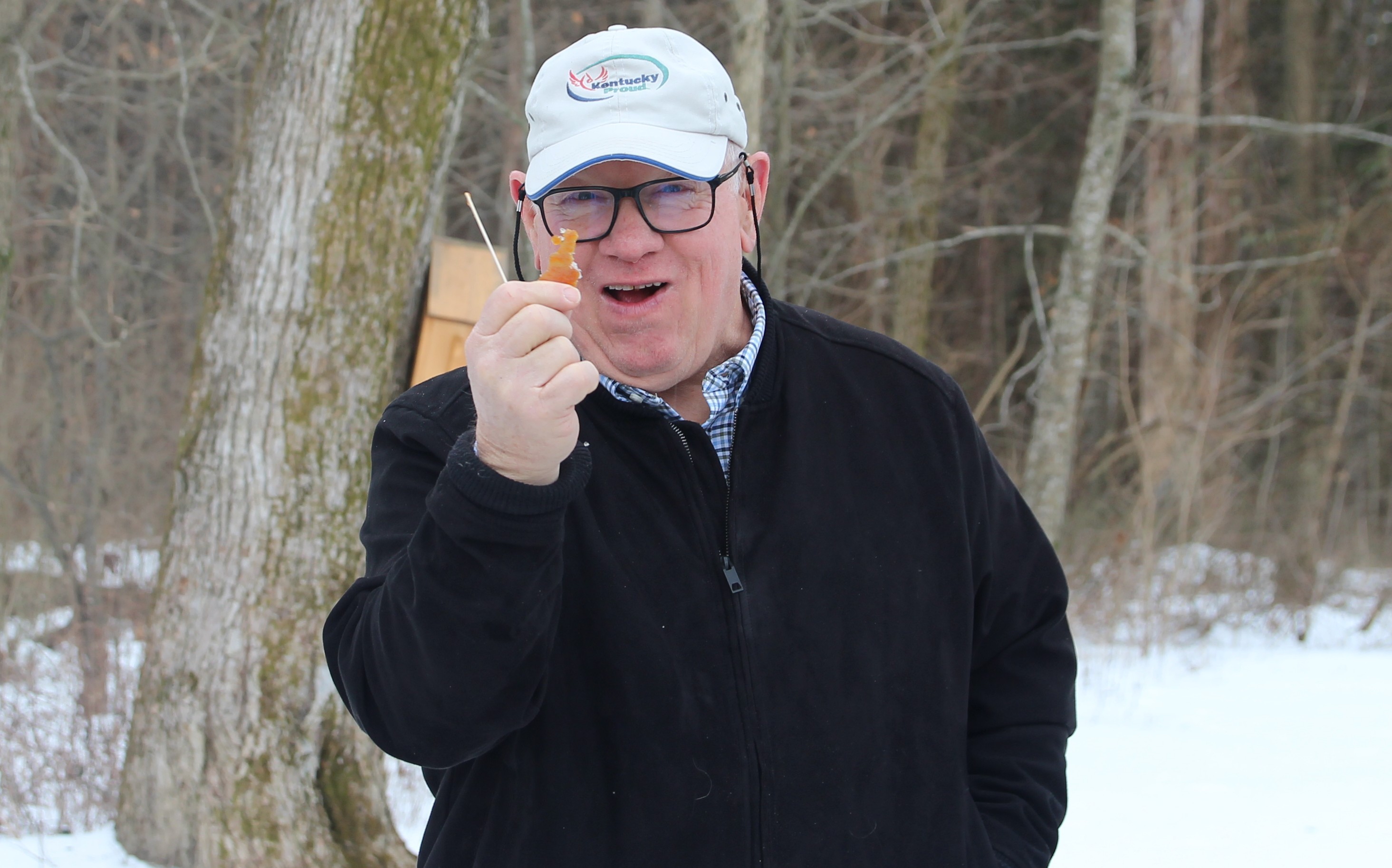
Kentucky Deputy Agriculture Commissioner Warren Beeler enjoys a piece of sweet and chewy maple taffy at Blues End Farm near Shelbyville. The farm will host Kentucky Maple Day from 11 a.m. to 3 p.m. Saturday, Feb. 21. Maple syrup production tours will take place every 45 minutes starting at 11:15 a.m., and maple taffy on snow will be served every hour starting at 11:45 a.m.
Maple syrup production making a resurgence in Kentucky
By Chris Aldridge
Kentucky Ag News
SHELBYVILLE, Ky. — When Doug Welch bought woodland property in Shelby County in 2005, he invited a state forester for a visit to see what economic potential it possessed. Welch thought he would suggest harvesting some trees for lumber or firewood, but the forester surprised him by asking, “So, are you going to make maple syrup?”
Welch had never thought of that. But with an abundance of maple trees behind his home, he read health food advocate Euell Gibbons’ 1962 book, “Stalking the Wild Asparagus,” which discusses tapping trees and producing homemade syrup.
“We tapped five trees and made maple syrup on our kitchen stove in 2006-07,” Welch remembered.
Last winter, Blues End Farm placed 188 taps on 187 trees. One tree, which Welch named “Big Momma,” can handle two taps.
“Every time we tap a tree, they cry, and we turn their tears into syrup,” Welch said.
Metal buckets that catch the sap weigh about eight pounds each when full, so harvest has been a grueling exercise. So, this year, Welch tapped 200 trees and installed tubes from each tree that drain the sap downhill to a collection point.
The sap from sugar and red maple trees, both native to Kentucky, is collected only during the winter months when the temperatures are below freezing at night and above freezing during the day. Sap flows when the trees thaw.
In Kentucky, tapping takes place in late December or early January by drilling a 5/16-inch hole 2 inches deep into each tree. A plastic hollow spout is tapped into the tree, and the sap will flow out of this tap into buckets or a tubing system like Welch’s.
The amount of maple syrup produced depends largely on the sugar content of the sap, which can fluctuate from tree to tree and season to season. In Kentucky, maple sap tends to be 1-2 percent sugar.
If the sap has a sugar content of 2 percent, it requires 43 gallons of sap to create one gallon of maple syrup. For sap measuring 1 percent, it takes 86 gallons to yield one gallon of maple syrup.
Syrup can be made from other trees, such as walnuts and sycamores, but maple is most common because its sap has a higher sugar content.
Maple sap must be boiled 10-15 hours to rid it of excess water. Welch installed a wood-fired reserve osmosis machine inside the farm’s “sugar shack” to remove some of the water so it doesn’t have to “cook” as long.
The boiling of the sap causes the sugars to caramelize into a golden brown color. Nothing is added to pure maple syrup. It is simply pure tree sap boiled down until the sugar content is 66.5 percent.
“That’s when it’s legally syrup,” said John Duvall, president of the Kentucky Maple Syrup Association.
Kentucky has a long history of making maple syrup. Long before European explorers arrived, Native Americans condensed the sap into sugar. They collected maple sap and stored it in hollowed logs. They allowed the freezing nights to freeze the water, as the sugar does not freeze. The ice was then broken and removed, leaving behind a concentrated liquid. This cycle was repeated for several nights, after which hot stones from a fire would be added to the concentrated sap until only sugar remained.
Settlers adopted this practice but used more modern techniques, tapping the trees with hollow reeds and collecting sap in buckets. The sap was then boiled over a fire in a cast iron kettle. According to records, more maple syrup was produced in the U.S. in 1862 than today.
Maple syrup production made a brief resurgence in rural Kentucky when cane sugar was rationed during World War II. Today, the state is experiencing another resurgence thanks to modern technology, a changing economic landscape, and the entrepreneurial spirit of farmers harnessing the abundance of maple trees in the state to supplement their income.
“The thing about maple syrup,” Duvall said, “is it’s ag, it’s horticulture, and it’s forestry.”
Blues End Farm will host an educational event on Kentucky Maple Day from 11 a.m. to 3 p.m. Saturday, Feb. 21. Maple syrup production tours will take place every 45 minutes starting at 11:15 a.m., and maple taffy on snow will be served every hour starting at 11:45 a.m.
In addition to producing maple syrup, Blues End Farm, named because it’s “where your blues end,” grows u-pick blueberries and raises pastured laying hens for eggs.
Treats such as maple blueberry scones and maple iced cookies will be available for sale on Kentucky Maple Day, in addition to maple syrup and pastured eggs.
For more information on Blues End Farm, go to www.Blues-End.com.