
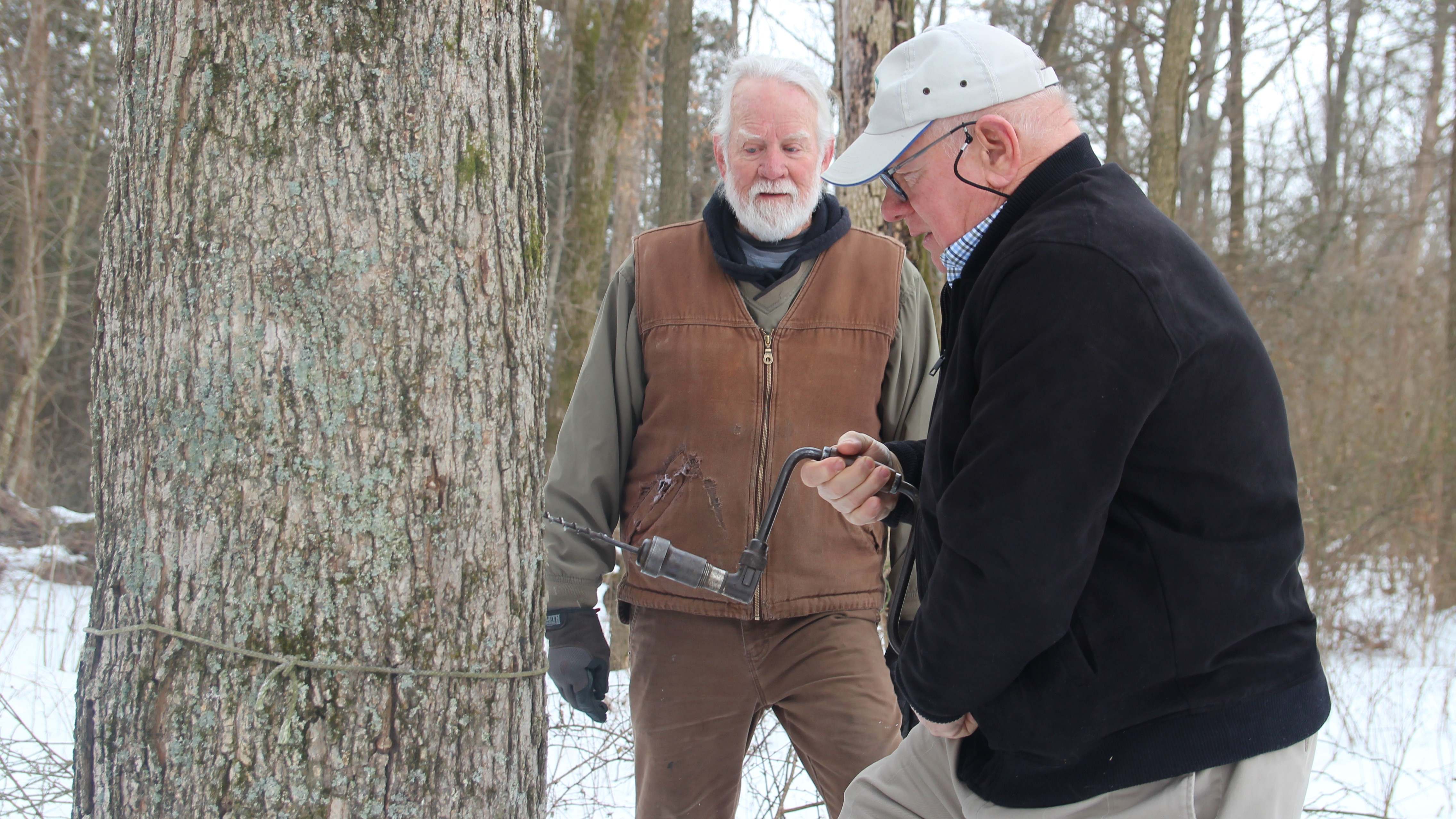
Kentucky Deputy Agriculture Commissioner Warren Beeler, right, uses a drill to tap one of the maple trees on Blues End Farm as farm owner Doug Welch looks on. The Shelby County farm tapped 200 of its maple trees this year, and the sap will be boiled down into syrup. (Kentucky Department of Agriculture)
Maple syrup puts sweet stamp on February
Ag Commissioner proclaims February as Maple Syrup Month
SHELBYVILLE, Ky. (Feb. 6, 2026) – Kentucky maple syrup enthusiasts joined Kentucky Agriculture Department officials at Blue Ends Farm in Shelbyville today to tap some maple trees and proclaim February as Maple Syrup Month in Kentucky.
“Maple syrup production has a storied history in Kentucky,” Agriculture Commissioner Jonathan Shell said. “Through the years, production may have lessened but it’s making a resurgence and Kentucky is certainly blessed to see that. It adds that sweetness to Kentucky agriculture.”
In Kentucky, maple syrup production can be traced back to Native Americans long before Europeans arrived, according to the Kentucky Maple Syrup Association (KMSA). However, Native Americans used the tree sap to create sugar, not syrup. Settlers adopted the practice but modernized it and made sugar and syrup from the sap.
The practice trickled off until the 1940s when sugar was rationed and many rural Kentuckians went back to the practice of tapping trees for sap and making their own sweeteners to cope with the shortage. But when times got a little easier, many stepped away from the tree tapping practice. Today, however, Kentucky is seeing yet another resurgence in maple syrup production. Farmers are harnessing modern technology, a changing economic landscape, and that same entrepreneurial spirit that brought Europeans to Kentucky, to tap into the abundance of maple trees in the state to bring Kentucky maple syrup back to the table.
“While Kentucky sits just south of traditional maple regions, our forests are full of maple trees representing a largely untapped resource with the potential to grow the state’s agricultural economy through syrup production,” said John Duvall, KMSA president.
KMSA boasts a growing membership of about 50 producers from Pike County in Eastern Kentucky to Graves County in Western Kentucky and all points in between. Through educational events and invitations from members to tour their properties, the Association works to spread the word and grow maple syrup production in Kentucky.
Those efforts have been aided along the way by the University of Kentucky Forestry Extension, UK’s Department of Forestry and Natural Resources, and the Kentucky Division of Forestry.
There are more than 30 species of trees that can be used for syrup, Duvall said. And unlike other forest industries, syrup production doesn’t require the harvesting of the tree itself, helping sustain forest land and agricultural landscape.
Although there are more than 100 maple syrup producers operating across the Commonwealth, many of them small family farms, Kentucky’s large forested areas poise the state for growth in the industry aligning with Kentucky’s goals of sustainable agriculture, agritourism, and value-added farm products.
Those interested in learning more can visit KMSA’s website can attend a host of education opportunities the Association puts on throughout the year. In February, KMSA hosts Kentucky Maple Days, Feb. 7 and Feb. 21, where Kentucky producers open their farms for tours and demonstrations and visitors can buy products straight from producers. A list of participating producers can be found on KMSA’s website.
“It’s amazing what can be made out of the maple syrup,” Duvall said. “From candies to maple covered nuts and even maple cotton candy, if you use refined sugar in your recipes, you can replace it with maple syrup.”
Those interested can find out more on the Kentucky Maple Syrup Association website, at kymaplesyrup.com or its Facebook page.